

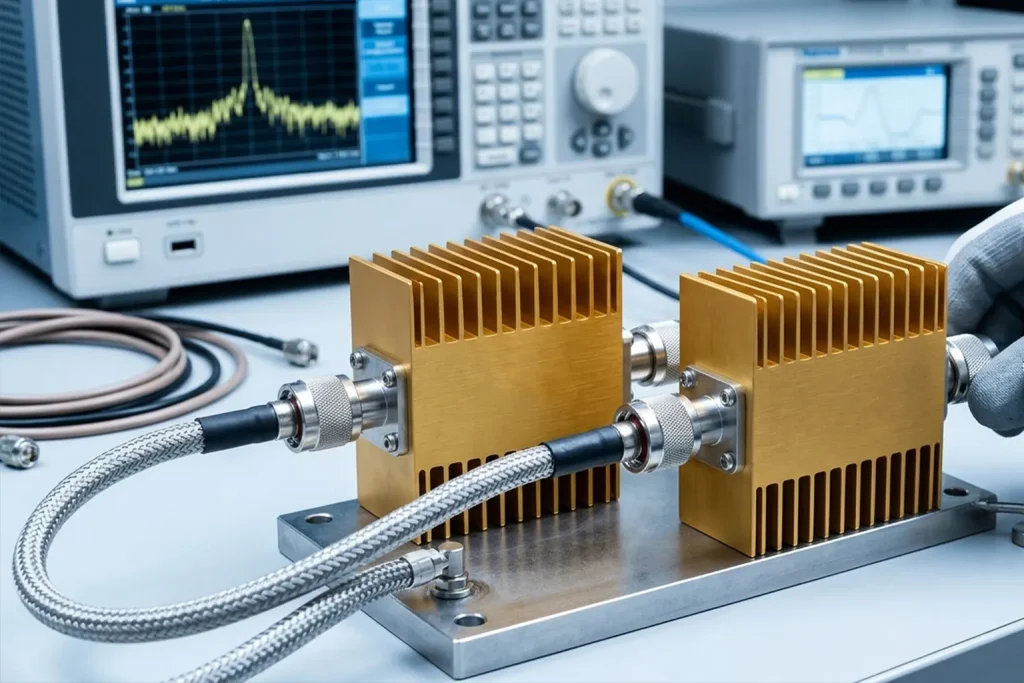
In the realm of wireless communication, encompassing both research and development facilities and extensive Distributed Antenna System (DAS) implementations, RF Loads and RF Attenuators function as crucial yet often overlooked elements within the RF signal chain. The worldwide deployment of 5G Sub-6GHz networks presents these passive components with novel and significant challenges, including elevated power densities, wider frequency ranges, and more stringent Passive Intermodulation (PIM) specifications.
This article explores the design core, thermal management mechanisms, and selection logic for these components in high-power testing environments.
1. RF Loads: The Physical Boundaries of Energy Termination
An RF Load (also known as a Termination Load) is essentially a high-precision resistor. In a standard 50-ohm system, its primary task is to absorb all incident RF energy and convert it into heat, with reflected signals (standing waves) approaching zero.
Impedance Matching and VSWR Control
In high-power environments, the internal resistive film (typically thin-film or ceramic) heats up rapidly. Due to the Temperature Coefficient of Resistance (TCR), the resistance value may shift as heat builds. If this shift moves too far from the 50-ohm standard, the Voltage Standing Wave Ratio (VSWR) will rise. Engineers need to be aware that reflected waves can potentially damage expensive Power Amplifiers (PAs).
High-performance loads use precision compensation technology to ensure that even at full power, the VSWR remains below 1.20:1, significantly enhancing system safety.
Thermal Management and Heat Sink Design
For high-power loads exceeding 100W, thermal efficiency determines the component’s lifespan.
- Conductive Cooling: The thermal interface between the core resistor and the aluminum alloy housing must have extremely high thermal conductivity.
- Convective Cooling: The geometry of the external heat sink—specifically fin spacing and thickness—is optimized via fluid dynamics to maximize surface area. Anodized finishes not only prevent corrosion but also improve thermal emissivity, allowing the device to shed heat more effectively without forced air cooling.
2. RF Attenuators: Precision Surgery for Signal Intensity
Unlike a load, an attenuator must process energy while maintaining signal “purity.” It is a two-port network designed to reduce signal power by a specific decibel (dB) value, protecting sensitive downstream equipment like Spectrum Analyzers or Vector Network Analyzers.
Wideband Flatness
Across the ultra-wide frequency range of 698MHz to 6000MHz, an attenuator must maintain exceptional frequency response flatness. For example, if a 30dB attenuator provides 30dB at 3.5GHz but shifts to 32dB at 4.9GHz, this 2dB deviation could invalidate an entire test link’s data. High-end passive components utilize microstrip compensation circuits to keep flatness within +/- 0.8dB across the entire spectrum.
Power Tolerance and Pulse Handling
In 5G TDD modes, signals exhibit pulse-like characteristics. An attenuator must be able to handle peak power levels significantly higher than its rated average power. If the internal resistive film doesn’t have enough resistance to pulses, a high instantaneous voltage could break through the film. This would cause permanent failure, even if the average power is within the specified limits.
3.The Impact of Connectors and Mechanical Specifications on Performance
In business-to-business procurement, especially for high-power applications, choosing the right interface is very important.
- N-Type : connectors are the workhorse for devices drawing between 50W and 200W. Their robust design allows them to handle frequencies reaching 11GHz.
- 7/16 DIN : For applications demanding low passive intermodulation (PIM) and high power levels exceeding 300W, 7/16 DIN connectors are the preferred choice. Their larger contact area is key to their performance.
- 4.3-10 Connectors: This is the new 5G standard interface. It takes up less space and is more stable electrically.
4.Tips for Selecting and Implementing in the Business
The rationale for your choice should shift based on the engineering requirements:
- Base Station Production Testing: Prioritize durability above all else. Opt for connectors crafted from robust copper alloys, ideally with Tri-metal plating to mitigate VSWR spikes caused by wear and tear.
- Precision Laboratory Measurement: Ensure accuracy and calibration.You need high-precision 30dB or 40dB attenuators to protect your expensive tools.
- Field maintenance outside: Put the environment first. IP65 or IP67 ratings are important to keep the resistive film from getting wet and corroding.
The last things that can go wrong with the quality of a wireless communication link are RF loads and attenuators. “Functional” isn’t enough anymore because the frequencies and power needs are higher.MS-TELERF are still committed to making sure that the passive parts they make will work with the world’s 5G infrastructure by carefully choosing materials and accurately simulating how they will work in the real world.
Related article

In the world of wireless communication and microwave engineering, if an amplifier is the “loudspeaker,” then an RF Attenuator is the precision …

In the high-demand world of wireless communication systems, Passive Intermodulation (PIM) is one of the most critical technical indicators affecting system performance. …