

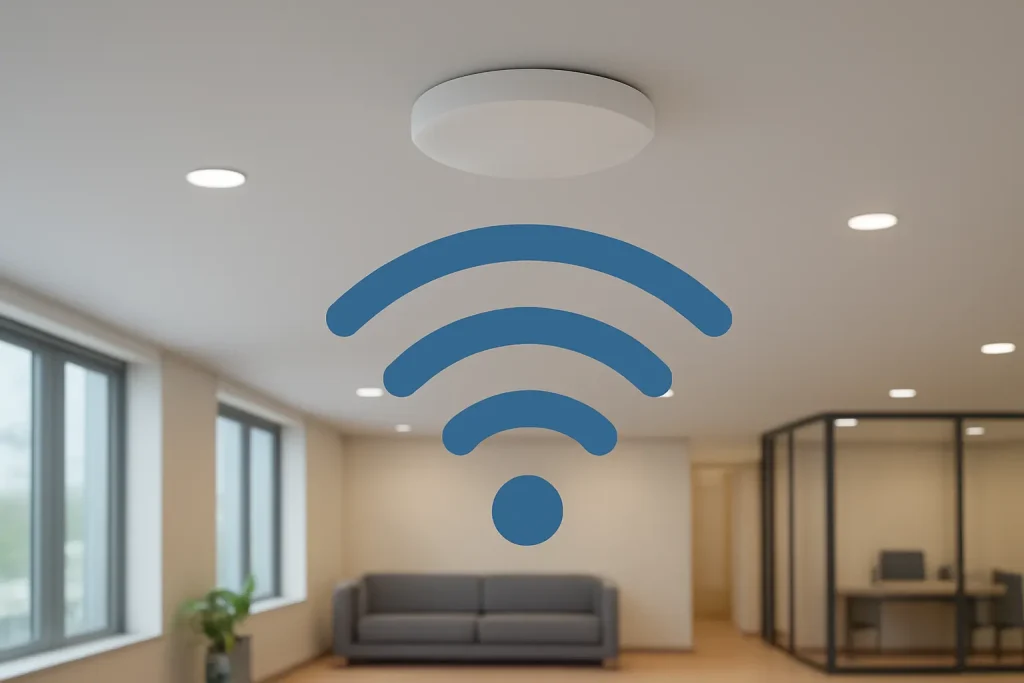
1. What Is a Distributed Antenna System (DAS)?
In today’s hyper-connected world, seamless wireless connectivity is no longer a luxury—it’s a necessity. As businesses and public spaces grow more crowded with devices, delivering reliable coverage across large, complex buildings becomes a challenge. A Distributed Antenna System (DAS) offers the perfect solution, improving indoor signal quality and capacity by distributing wireless signals from a central source through a network of strategically placed antennas.
Whether for offices, shopping malls, or hospitals, DAS ensures that no area is left behind, providing optimal coverage even in the most challenging environments.
2. Why Ceiling Omni Antennas Are Essential for DAS
Indoor DAS is built on a foundation of high-performance antennas that provide coverage in hard-to-reach areas. Ceiling-mounted omni antennas are designed to provide a 360° signal distribution, making them ideal for large indoor spaces. Their ability to radiate signals in all directions ensures consistent coverage without dead spots, and their discrete ceiling installation keeps them out of sight while providing maximum performance.
In environments where every inch counts, ceiling-mounted omni antennas deliver reliable, wide-area coverage while blending seamlessly into the environment.
3. Key Features of Ceiling Omni Antennas for DAS
- Wideband Coverage
For a DAS to support a wide array of wireless technologies, antennas must be able to operate across multiple frequency bands. The ability to cover 350 MHz to 6000 MHz, for example, allows antennas to be compatible with 2G, 3G, 4G, 5G, and IoT devices. This versatility simplifies installation and reduces the need for multiple different antennas, making the network easier to manage.
- Low PIM (Passive Intermodulation)
One of the most critical factors in antenna selection for DAS systems is low PIM performance. High PIM levels can cause interference, reducing network throughput and signal quality. Antennas with low PIM designs ensure clear, interference-free signals, enabling better performance in environments where multiple carriers and devices are sharing the same system.
- Polarization and Gain
Polarization affects how signals are received. Dual polarization antennas, which use both vertical and horizontal planes, offer greater flexibility and ensure better signal reception. Additionally, gain plays a pivotal role in determining how far a signal will travel and how consistently it will cover an area. The right balance of gain can ensure that signals reach all corners of a building without causing interference.
4. How to Choose the Right Ceiling Omni Antenna for Your DAS
Choosing the right antenna is a delicate balance of technical requirements and environmental factors. Consider the following when selecting a ceiling-mounted omni antenna:
- Frequency Range: Ensure the antenna covers the required frequency bands for your network. A wide frequency range (e.g., 350 MHz–6000 MHz) is ideal for multi-system compatibility.
- Low PIM: Look for antennas designed to minimize PIM, especially in areas where multiple carriers or technologies are present.
- Size and Aesthetics: The antenna should fit seamlessly into the environment. Ceiling-mounted antennas often offer the best aesthetic integration, providing a clean, professional look.
- Gain vs. Coverage: While higher gain increases signal strength, it can reduce the coverage area. Choose antennas with the right balance of gain to ensure even distribution across the space.
5. Application Scenarios for Ceiling Omni Antennas in DAS
Ceiling omni antennas are highly versatile and are used in a variety of indoor environments, including:
- Commercial Buildings: Offices, conference rooms, and retail spaces benefit from ceiling-mounted omni antennas for seamless connectivity.
- Public Infrastructure: Airports, subway stations, and shopping malls need reliable coverage in large, dense spaces with thousands of users.
- Healthcare Facilities: Hospitals require consistent, high-quality signal coverage for medical devices, mobile devices, and staff communication.
- Industrial Environments: Factories and warehouses often have large, open spaces where even signal distribution is crucial for safety and operations.
Each of these environments benefits from the wide, consistent coverage provided by omni antennas, allowing for continuous, uninterrupted communication.
6. Installation Tips for Ceiling Omni Antennas
Proper installation is key to maximizing the performance of ceiling omni antennas. Here are some tips for successful deployment:
- Positioning: Install antennas at appropriate heights to ensure even signal distribution. Ceiling-mounted antennas should be placed centrally to minimize signal loss.
- Use Low-Loss Cables: Use low-loss RF cables to connect the antenna to the DAS system. This reduces signal attenuation and ensures that the signal reaches all areas with minimal loss.
- Test for Optimal Performance: After installation, conduct thorough testing to ensure the signal is consistent and covers all desired areas without interference. This is essential for fine-tuning the network.
7. Why Ceiling Omni Antennas Are the Go-To Choice for Indoor DAS
Ceiling omni antennas are a favorite for indoor DAS systems due to their combination of performance, ease of installation, and aesthetic integration. Their wideband coverage, low PIM performance, and sleek design make them the perfect fit for modern buildings and complex wireless environments.
They not only provide reliable service but also ensure that networks are future-proof, supporting the growth of 5G, IoT, and beyond.
8. Future Trends in Ceiling Omni Antennas
The future of indoor wireless networks lies in smarter, more adaptive antennas. As DAS evolves, antennas are becoming smaller, more intelligent, and more efficient. The future will see more antennas with adaptive beamforming capabilities, optimized for different network requirements and able to adjust to changing conditions in real-time.
This shift towards smarter antennas, combined with AI-assisted optimization and IoT integration, will redefine how we manage indoor wireless coverage in the years to come. Building automation systems will likely integrate with DAS, enabling a level of self-healing coverage that maximizes network efficiency and user experience.
Related products

698–6000MHz Omni Ceiling Antenna with Low PIM
Ceiling AntennaHigh Gain Low PIM Omni Ceiling Antenna | 617–4000MHz
Ceiling AntennaHigh Gain Slim Omni Ceiling Antenna | 698–2700MHz | Low PIM
Ceiling Antenna


Related article

In today’s multi-band and multi-standard 5G and LTE networks, Distributed Antenna Systems (DAS) and In-Building Systems (IBS) play a vital role in …

In RF system design and optimization, engineers often focus on active components — such as power amplifiers, transceiver modules, and baseband units.However, …