

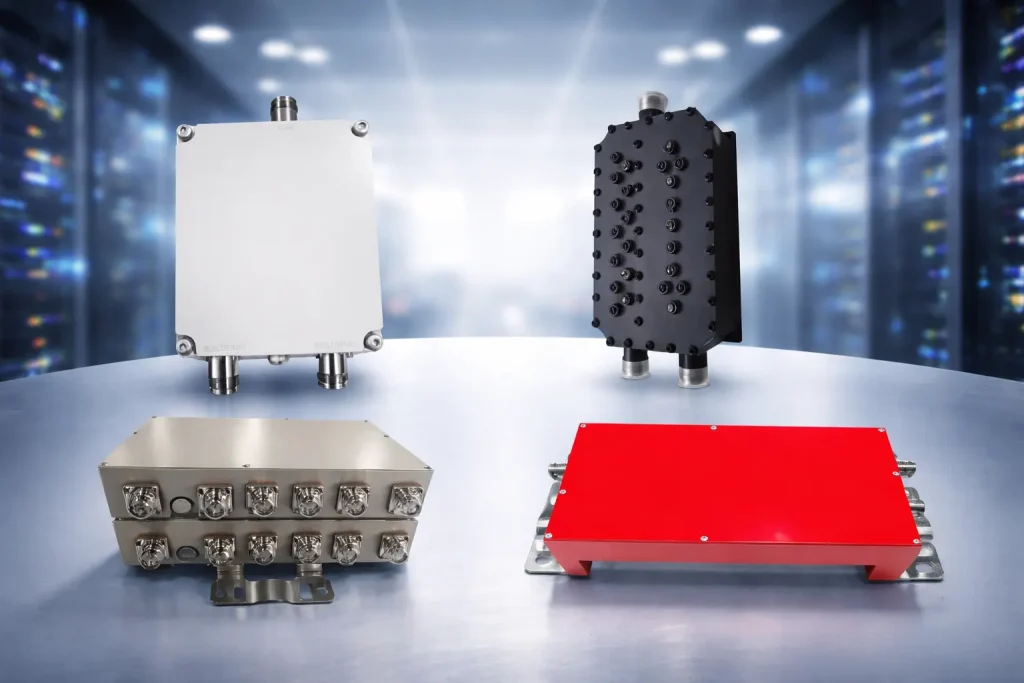
1.Why Do You Need an RF Combiner?
In field engineering, the biggest headache is often limited antenna space or the nightmare of pulling too many cables. If you have signals from different carriers (like Verizon, AT&T, and T-Mobile) plus a Public Safety radio signal, installing a separate antenna for each would clutter the rooftop and elevator shafts beyond capacity.
An RF Combiner is the “traffic controller” for this situation. It “twists” several different signal sources together so that only one cable is needed to connect to the antenna. Why is it better than just splicing wires? Because it ensures:
- No Backflow: A signal from Port A won’t flow back into the transmitter at Port B, which prevents equipment from burning out.
- Impedance Stability: RF systems rely on a strict 50-ohm standard. Splicing wires ruins the impedance, causing the signal to reflect back instead of transmitting.
2.How Does It Work? (The Engineering Logic)
Internally, a combiner works like a system of “one-way streets.”
By using precise physical structures—such as metal cavities or specific trace lengths on a PCB—it allows designated frequencies to pass through while blocking unwanted ones.
- Physical Cancellation: It uses the phase difference of electromagnetic waves. It makes the desired signals “stack up” (additive interference) to become stronger, while making the unwanted interference signals cancel themselves out. In the industry, we call this Port Isolation.
3.Pros and Cons of RF Combiners (The Honest Truth)
Pros:
- Cost & Labor Savings: Fewer cables and fewer antenna mounts mean direct savings in hardware and man-hours.
- Isolation Protection: It acts like a firewall, blocking mutual interference (intermodulation) between different frequencies.
- Massive Integration: It can consolidate everything from 600MHz up to 7000MHz into a single link.
Cons:
- Inevitable Loss: Signals get weaker as they pass through any device. While frequency-selective combiners have low loss, “same-frequency” combiners (like 3dB Hybrid Couplers) lose 50% of the power (3dB) every time they merge two signals. This is physics; it can’t be avoided.
- Heat Generation: That “lost” power turns into heat. If you are running 200W high power, the combiner will get hot. If the cooling isn’t sufficient, the internal parts can expand, causing performance to tank.
- PIM (Passive Intermodulation) Risks: If the internal craftsmanship is poor, it creates “noise” called PIM. This results in a phone showing full signal bars but having incredibly slow data speeds.

4.Real-World Selection: Which One Should You Buy?
A. The 5G “All-Rounder”: 5-in-1 Wideband (690-4000MHz)
If you want to merge 5G (3.5GHz) with older 4G/LTE bands, this is your go-to.

- Plain Talk: Think of this as a “5-port warehouse.” The key advantage is the Low PIM (-155dBc), which ensures that even with many signals, you won’t create noise that kills 5G data rates.
B. High Isolation Expert: 790-2700MHz Penta-Band
This is the workhorse for standard urban DAS (Distributed Antenna Systems).

- Product: 790-2700MHz Penta-Band RF Combiner
- Plain Talk: This one uses a “Cavity” structure. It’s a bit larger, but the isolation is top-tier. When five signals are shoved into one pipe, they want to interfere. This unit keeps them strictly in their own lanes.
C. Future-Proof Expansion: Ultra-Wideband (Up to 7125MHz)
If you are planning for Wi-Fi 6E/7 or the upcoming 6GHz 5G bands, use this.

- Product: 698-7125MHz Tri-Band RF Triplexer
- Plain Talk: Most combiners stop at 3GHz or 4GHz. This one goes up to over 7GHz. It’s an “investment” piece—when carriers upgrade to 6GHz later, you won’t have to tear down the antennas and replace the combiners.
5. “Pro Tips” for Selection and Installation
- Don’t Just Chase the Lowest Price: Cheap combiners might use poor aluminum plating. After six months in the field, the PIM specs will degrade. Choose units with full copper or high-precision aluminum cavities with tri-metal plating.
- Tighten Every Connector: For high-power setups (200W+), you must use a torque wrench on N-type or 4.3-10 connectors. A loose connection acts like a “spark plug,” creating massive interference.
- PIM is King: In the 5G era, PIM must be -150dBc or better. Otherwise, your combiner becomes a “noise generator.”
6. We Don’t Just Sell—We Customize
RF engineering is rarely “one size fits all.” Every site has a different frequency plan.
At MS-Telerf, our strength is customization: Regardless of the frequency bands you need, the power rating (even 200W+), or the number of ports—we can design and manufacture it specifically for your project. We are a true manufacturing factory, and all our Low PIM specs are verified by high-end analyzers to ensure field reliability.

1.How It Works: The Physics of Coupling A Directional Coupler is a fundamental passive RF component designed to achieve directional sampling of …

In microwave engineering, connectors are often dismissed as simple hardware. In reality, they are the most critical junctions in any RF system. …