

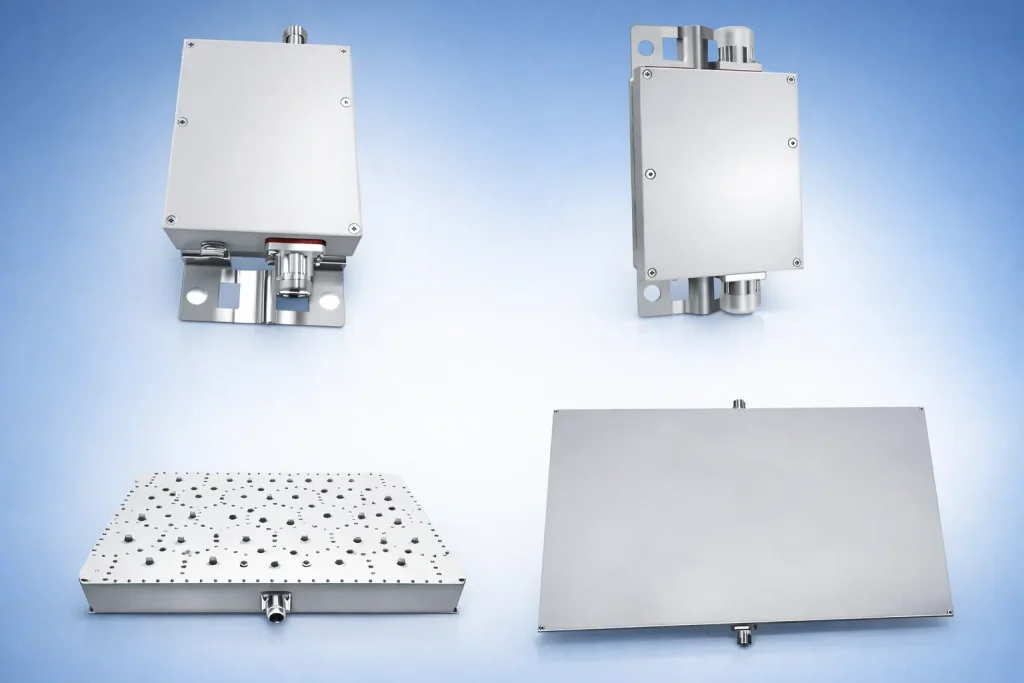
In the increasingly crowded radio frequency spectrum, the ability to isolate a specific signal while rejecting unwanted noise is paramount. This is the role of the RF Filter. Whether in a smartphone, a satellite receiver, or a 5G base station, RF filters act as the “gatekeepers” of frequency.
At MS-Telerf, we specialize in high-performance filtering solutions. This guide explains the types, technologies, and critical importance of RF filters in modern telecommunications.
1. Defining the RF Filter
An RF Filter is a passive component designed to allow signals within a specific frequency range (the “passband”) to pass through, while significantly attenuating (blocking) signals in other frequency ranges (the “stopband”).
Why are they necessary?
Without filters, RF receivers would be overwhelmed by interference from neighboring channels, leading to dropped calls, slow data speeds, and complete system failure.
2. The Four Primary Types of RF Filters
Based on how they treat different frequencies, RF filters are categorized into four fundamental types:
A. Low-Pass Filter (LPF)
Allows frequencies below a specific “cutoff” frequency to pass and blocks everything above it.
- Use Case: Removing high-frequency harmonics from a power amplifier output.
B. High-Pass Filter (HPF)
Allows frequencies above a specific cutoff to pass and blocks everything below it.
- Use Case: Protecting a receiver from low-frequency interference like FM radio or power lines.
C. Band-Pass Filter (BPF)
The most common type in wireless comms. It allows a specific “window” of frequencies to pass.
- Use Case: Isolating a single 4G or 5G frequency band (e.g., N78 band).
D. Band-Stop Filter (Notch Filter)
The opposite of a band-pass; it blocks a very specific narrow range of frequencies while letting everything else through.
- Use Case: Eliminating a specific known interference source, such as a nearby radar or broadcast tower.
3. Common Manufacturing Technologies
The construction of an RF filter determines its power handling, size, and precision.
| Technology | Best For | Key Advantage |
| Cavity Filters | Base Stations / DAS | High power handling, ultra-low insertion loss. |
| SAW/BAW Filters | Mobile Phones | Extremely small footprint. |
| LC Filters | Low Frequency / PCB | Cheap and easy to integrate on boards. |
| Ceramic Filters | Commercial Radio | Good balance of size and performance. |
4. Pros and Cons of RF Filters
Advantages
- Interference Mitigation: Essential for “co-existence” in multi-operator environments.
- Improved Signal-to-Noise Ratio (SNR): By blocking noise, the desired signal becomes much clearer.
- Hardware Protection: Prevents out-of-band high-power signals from damaging sensitive LNA (Low Noise Amplifier) stages.
Disadvantages
- Insertion Loss: No filter is perfect; they always absorb a small amount of the desired signal’s energy.
- Group Delay: Filtering can sometimes distort the phase or timing of a digital signal.
- Size vs. Performance: High-rejection filters (especially cavity types) are physically large and heavy.
5. Critical Applications in the 5G Era
I. 5G/4G Interference Mitigation
With the rollout of 5G, many legacy systems (like C-Band satellite) face interference. Band-pass filters are installed on satellite dishes to block 5G signals while keeping the satellite data intact.
II. Site Sharing & Co-location
In modern DAS (Distributed Antenna Systems), multiple technologies (WiFi, LTE, 5G, Public Safety) share the same infrastructure. Filters ensure that the WiFi signal doesn’t interfere with the Public Safety radio.
III. Harmonic Suppression
Transmitters naturally produce “harmonics” (multiples of the main signal). RF filters ensure these harmonics are suppressed to meet strict FCC and international regulatory standards.
6. How to Select the Right RF Filter?
When browsing the catalog at MS Telerf, focus on these four metrics:
- Center Frequency (): The frequency you want to pass.
- Bandwidth: How wide the “window” is.
- Rejection: How many decibels (dB) of noise the filter blocks in the stopband.
- Insertion Loss: How much signal strength you lose in the passband (lower is better).
Related article

In the evolving landscape of 5G and high-capacity wireless networks, managing RF signals with precision is more critical than ever. The Hybrid …

1.Why Do You Need an RF Combiner? In field engineering, the biggest headache is often limited antenna space or the nightmare of …